Why pay someone when I can do it myself?

You still need to build wings, seats, landing gear and beverage carts, too. Seriously, it's easier to just visit Southwest.com

Because sometimes it makes sense.

It’s called Ricardo’s Law of Comparative Advantage. It says that things work best when everyone does what they’re best at. Ignore it, and you’ll hurt yourself financially.

Say you work as a salaried salesperson, but you also happen to be a capable amateur gardener, and can trim 50 tree branches an hour.

(sigh) Why does there always have to be math?

There’s very little math. Stop whining.

A mustachioed man wearing a Chivas USA cap knocks on your door, and explains in broken English that he’d like to trim your branches for $9 an hour. You reluctantly agree, even though hiring him means depriving yourself of a relaxing pastime.

So you hire him, and find out he’s half the gardener you are: he takes an hour to trim 25 branches. Should you grab the garden shears out of his hand (points facing downward), say you’ll do it yourself and fire him?

No.

If you earn $40 an hour, forgoing an hour of that to trim your branches makes no economic sense. Better to pay Javier $18 to do it and free up your time.

But if you really enjoy gardening that much, then yeah, go ahead and garden.

Real life example: we have a woman who cleans the house fortnightly. She charges $100, takes her time (usually about 8 hours), and is amazing. Of course we could clean the house ourselves, but it’s easy for us to get distracted. Whereas for our housekeeper, our house is strictly a place of business – not somewhere to walk around naked and listen to loud music in. (As far as we know. We try to stay away on days she visits.)

But she’s good at what she does. It’d take us longer than it takes her, and even though it’s our place, we admit we wouldn’t be as thorough. Also, we hate cleaning. (That being said, we’re still the kind of people who will spiff the place up, at least a little, for the housekeeper’s arrival.) We also don’t have the fancy equipment she has, nor would we be willing to invest in such. Furthermore, we travel frequently enough that it’s sometimes worth it just to have her there to feed and water the cats, which can allow us to extend some trips by a day or two.

If you don’t enjoy doing something, and the professionals don’t charge an exorbitant amount to do it themselves, it’s perfectly fine to hand them the wheel.

Are there exceptions? Well, what do you enjoy doing?

An example: changing motor oil. Again, there’s a capital investment involved. We happen to drive SUVs that require more oil than that effete little subcompact you drive to Whole Foods in. This isn’t a primer on how to change your oil, but here’s the list of ingredients:

6 quarts of synthetic blend $24
Filter $4
Pan $3
Cap wrench $8
Swivel wrench $14
Jack $140
Jackstands $90

That’s about it. Everything else, you can steal.

Go to Jiffy Lube, you pay $35 for a synthetic blend change. We save $7 by doing it at home, but have to buy $255 worth of additional equipment. It’ll take 47 oil changes for the capital investment (most of that involved in getting the truck off the ground) to pay off.

But this is for 2 SUV’s*, so that’s 23 oil changes apiece. Say we average 4000 miles between changes, that’s 92,000 miles each. And we can use the jack and stands for other maintenance, too.

Jiffy Lube techs have an underground station and muscle memory – their least competent employee can change oil far faster than yours truly can jack up the SUV. However, we’re at their mercy as far as getting in, jiffily or otherwise. Meanwhile, there’s zero wait time in our garage.

Also, they’ll test the vehicle’s battery**, recommend an unneeded replacement of an air filter***, maybe find a few other things wrong. Some of those might even be legitimate.

The psychological reward for changing your own oil is substantial, too. Chicks claim that they dig scars, but what really gets them hot is grease-stained hands.

On the flip side, paying someone to do what you can isn’t necessarily bad nor even something to discourage. You can eat every meal at home, but every now and then it’s only natural to want to leave your palate in the hands of a professional cook (and your dirty dishes in the hands of professional bussers.)

*We normally use “trucks” to describe what we drive, simply because they carry lots of cargo and we take them off-road. However, if they were authentic trucks in the F-150 or Tundra or Ridgeline sense, they’d have an extra inch of clearance or so – possibly just enough to allow a normal-sized person to get underneath without spending $230 on hydraulics and accessories. Thus our use of the term “SUVs”.

**A battery tester can cost $80. Seeing as that’s almost the price of a battery, is it worth it if you’re going to change your oil at home instead of getting a free test and readout at a professional oil change place? Well, while batteries die gradually, it’s pretty hard to perceive their imminent death without a tester. You’ll just wake up one day and she’ll be cold and unresponsive. Which she was going to be anyway. Jumper cables get you to the AutoZone, where they’ll test your battery without charge (haw!) and install a new one, also without charge. Well, they’ll charge you to buy it, that is. And you can assume it’ll be charged. Dropping it in place will be on the house. But it’ll still be charged. For no charge.

***If you plan to keep your car for even as little as 25,000 miles, buy a K&N filter.  They cost 5 times more than standard air filters, but you can wash and reuse K&Ns. And they come with a million-mile guarantee.

**This article was a #1 pick in the Best of Money Carnival 103rd Edition**

and
The Festival of Frugality #280

Months later, this book is still garbage I

Oh yes, there will be a Months later, this book is still garbage II. And III.

It’s Recycle Friday at Control Your Cash, in which we post a classic that another blog already posted months ago. This week that blog is the eclectic Financial Highway, and the post is a review of one of the worst personal finance books ever written. The guy who runs Financial Highway asked us to review it, and we did. Oh God, did we review it. And probably would have made its author cry, if he weren’t a lawyer and didn’t have tear ducts.

Yes, Trent at The Simple Dollar loved the book. Which tells you as much about its worth as our review did. Does. Will do. Here, read it. Our review, that is. Not the book:

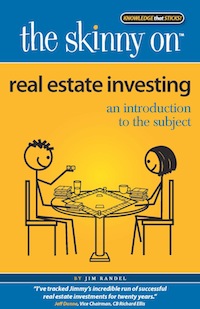
When I consented to review The Skinny on Real Estate Investing, I assumed I’d be reviewing a book, and not a pamphlet illustrated by my 8-year old niece who drools a lot and still has some trouble negotiating bathroom time. This review might run longer than the book itself.

Jim Randel’s series of illustrated The Skinny on titles boasts that it’s “For Really Busy People!” It’s also suitable For Really Fidgety People who can’t get through a book longer than 10,000 words. The lengthiest passage is the introduction, which runs a full page and explains The Skinny on’s M.O. of culling swaths of information into a workable whole. But it doesn’t explain the distracting primary illustrations that adorn every page.

The jacket quotes all attest to Randel’s success as an investor, but none of them speak about the book itself.

Randel is an attorney, with condescension in his blood. He’s in love with his own (lame) sense of humor, and uses an asterisk in one panel with the footnote, “*Did you catch the metaphor?” No, I didn’t. Please explain it to me again, Attorney Boy, using something less complex than kindergarten sentences. Randel also has an amateur’s pedantic insistence on avoiding contractions, the bane of the self-important, self-published, self-righteous author. This makes for a book that is simultaneously juvenile and stilted. Maybe Randel avoids apostrophes because he can’t punctuate – he uses “+/-25%” where “~25%” should go, which makes a huge difference when calculating home values.

It’s barely possible to repeat yourself in a book this short, but he does. Did you know Randel was born in Perkins, Ohio? If you didn’t, don’t worry. He’ll tell you again. Several times.

He even puts a commercial for one of his other books right in the middle of the narrative.

The Skinny on Real Estate Investing is effectively a black-and-white comic book. It concerns a married stick-figure couple, ready to leave their workaday stick-figure lives and invest their way to stick-figure affluence. The husband gets suckered into attending a huckster’s “wealth-building” seminar – you know, because men are impulsive and scatterbrained while women are sensible and rational – when Randel himself jumps into the couple’s lives (literally, out of a plane) to right the ship.

Because he’s a lawyer, or perhaps because he never learned to write for someone other than himself, Randel shifts directly from first gear to lecturing overdrive. He starts this at the book’s quarter-mark (not coincidentally, when I first contemplated throwing The Skinny on Real Estate Investing in the swimming pool.) In the space of one panel, he goes from childish humor to the first edible meat of the book; this uninspired paragraph:

The key to all real estate investing is understanding what is called a cash-flow analysis. The logic of this analysis is the same whether you are buying a single-family house or a huge shopping center. The larger the property, the more numbers you need to review, but the methodology is the same.

The Drake Passage thinks The Skinny on Real Estate Investing is choppy. In another gem, Randel tells us that he’d only invest in a house if it “had an especially high likelihood for substantial appreciation.”

You mean, if its price was almost certain to rise a lot? Speak English. This book is short, but it’s anything but concise.

Randel explains legitimately important concepts like return on investment, leverage, cap rate and cash flow, but buries them in a style that no sane person will wallow through.

Adding value simply means finding ways to increase the value of your property


A square foot is a square that measures one foot by one foot

God, make it stop.

Randel moves effortlessly from simplistic to over the reader’s head. For instance, he drops a reference to Class A vs. Class B office space halfway through the book, but never bothers explaining it.* He adds that if you want to buy a property and you’re illiquid, you should ask the current owner to “take back a second mortgage”, again without explanation.

Even the layout is garbage. In some illustrated panels, the publisher uses a font visible only to prairie falcons. Sure enough, the content therein is some of the most valuable in the book.

(Randel uses a metaphor to explain how simple the math involved in real estate investing is: “it’s not ______!”

Guess what goes in the blank? No, not “rocket science”. The other one. But don’t fret: if you miss it on page 109, you can catch it again on page 156.)

I’m not sure which is more galling: Randel announcing that The Skinny on Real Estate Investing is just the first in a series; or him charging $14 for a book that clearly took him an afternoon to write, possibly a drunken one.

I got Randel’s insufferable little vanity project down to 41 words while losing no detail. Here’s every usable piece of knowledge in this book, in handy point form:

  • unlike with stocks and bonds, with real estate you can influence the return on your investment;
  • asking prices often mean nothing;
  • find partners, but keep a management fee for yourself;
  • don’t invest in real estate that doesn’t offer >10% cash-on-cash return.

What’s cash-on-cash return? Sorry, that’s a topic for another book.

_________________________________________

* There are 3 classes: A, B, and you can probably figure out the third. A Class “A” office building is at least 120,000 square feet. The term can even refer to multiple adjacent detached buildings that share an owner. A building this big should have a full-time property manager, maintenance person, and steward. There’s more to the definition than size, though — and almost all of it is subjective. A Class “A” building should be in a “good” neighborhood and have other amenities like covered parking and some sort of concentration on aesthetics. Class “A” means cachet for its tenants. A Class “A” building has at least 3 floors and can cost more than $200/square foot to build.

Class “C” is the bottom end of the market — for example, converted houses in old parts of town. Which means Class “B” is everything else — functional, decent buildings that were built for the express purpose of accommodating businesses, but aren’t places you would stick your chest out and brag about renting at.